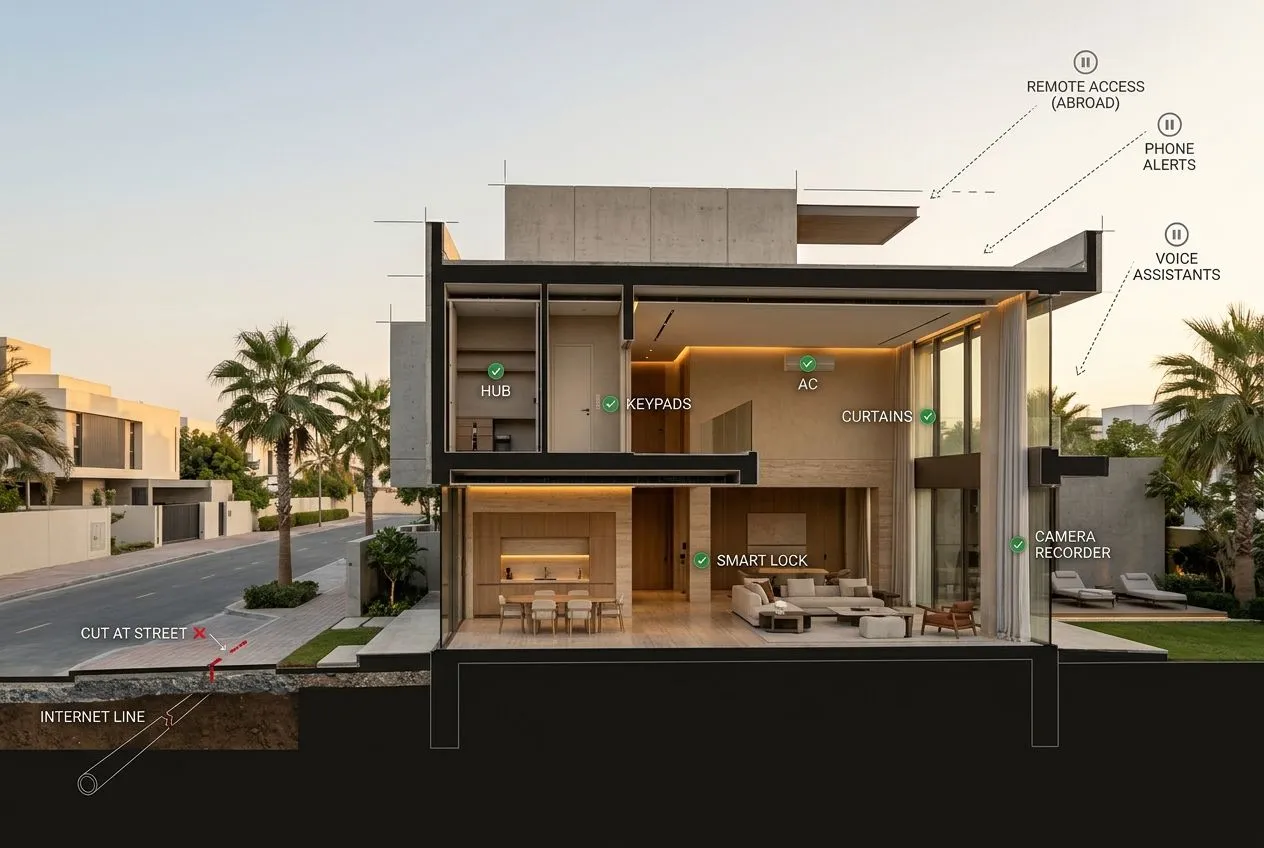
A local control smart home keeps working when the internet goes down. The hub (the small box that runs your system) sits in your home and makes its decisions there.
Your lights, AC, curtains and camera recordings stay under your control. You only need the internet for things like checking the house from the office or from abroad.
This guide explains cloud and local control in plain terms. It covers what still works offline in the systems we install, who holds the passwords, and how to keep your data inside your own walls.
What is the difference between cloud and local control?
With cloud control, every command leaves your home. You tap the app, the request travels over the internet to the maker's servers, and those servers tell your light to switch on. If the internet or the servers stop, the light stops responding too.
With local control, the hub in your home does the work. It takes a command from a keypad, a sensor or the app and sends it straight to the device. Nothing has to leave the building for the house to work.
Many systems mix the two. So ask any installer one plain question: which jobs need the internet, and which do not?
What keeps working when the internet goes down?
In the systems we design, everyday control runs inside your home. An internet cut does not leave you in the dark. Here is what carries on.
What pauses is anything that has to reach you, or us, from outside. That covers control while you are away and opening the door remotely for a visitor. It also covers phone alerts while you are out, and remote support from our team.
Our alarms send alerts to the app only. We do not have a monitoring centre in Dubai. The siren and automatic water shut-off depend on how we set up your system and what you need. Our engineer will go through this with you at the home visit.
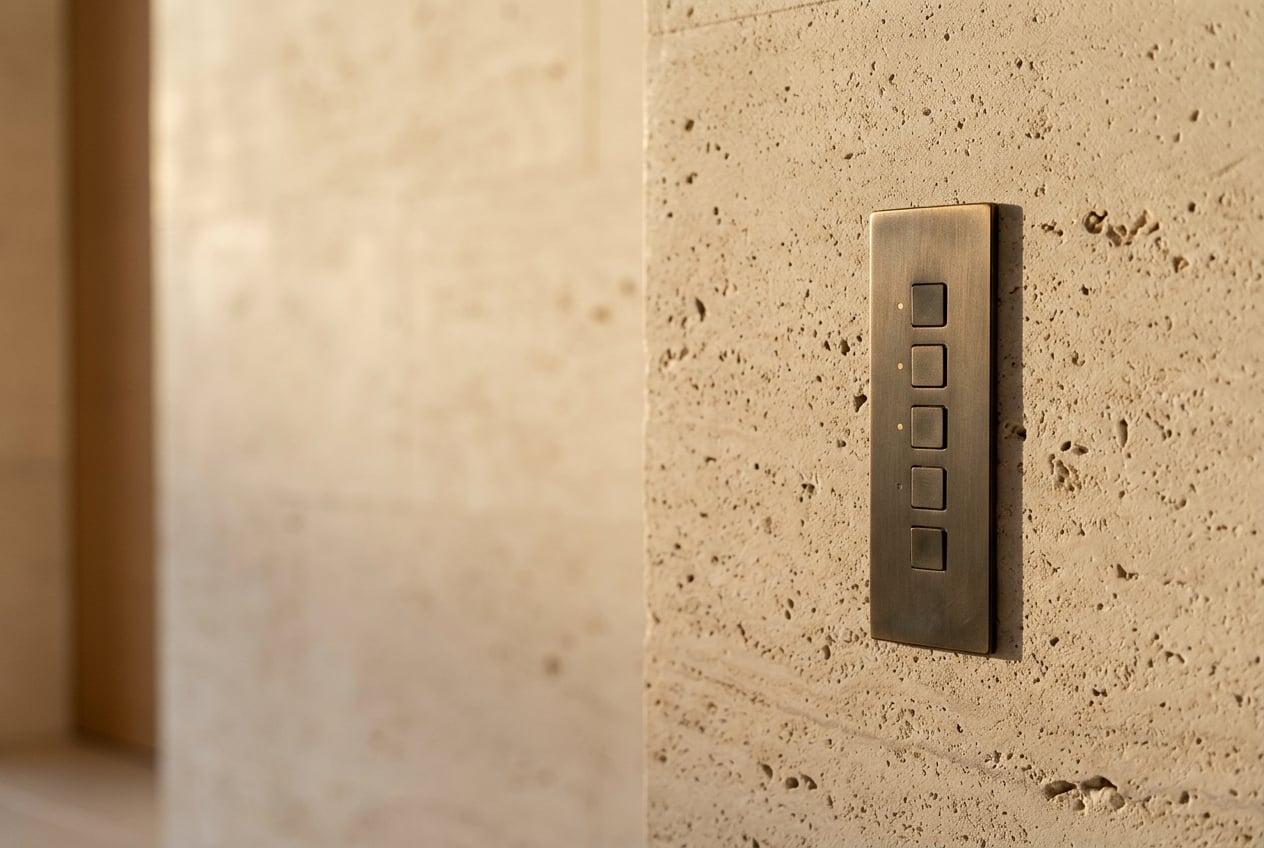
- Keypads and switches: lighting, scenes, AC and curtains keep responding, even if your home network goes down as well.
- The app at home: while your Wi-Fi is working, you can still control the house from your phone inside the home.
- Schedules: blinds that follow sunrise and sunset times or a light sensor keep moving on time.
- Garden watering: Rain Bird and Hunter irrigation schedules keep running.
- Smart locks: the keypad and fingerprint reader keep working at the door. The locks we recommend also have a physical key or an emergency power option for flat batteries.
- Cameras: recordings are saved on a recorder in your home, so recording carries on.
Why does local control help your privacy?
Data that stays in your home is easier to keep private. When the hub runs the house, nobody else's server needs a record of your day. That includes when you switch on lights, open the door or change the AC.
Cameras matter most here. In the UniFi Protect systems we fit, all recordings are saved in your home, and cloud backup is an option you choose. Everything stays in your control.
Cloud-only devices carry a second risk: they depend on the maker keeping its servers running. Nest switched off the Revolv hub for good on 15 May 2016. In April 2022 Insteon's cloud servers stopped working without notice, and its customers lost the service they relied on.
Voice assistants need a separate check. We connect Amazon Alexa, Google Assistant and Apple Siri. Alexa needs the internet for most commands, and only some Echo devices can control a few devices offline. Apple's Siri handles some requests on the phone itself, but not all. So plan for voice control to pause during an internet cut, and use keypads as your main way to run the house.
Who holds the passwords to your system?
You do. At handover we give you the ETS project file (the programming file for a KNX system) and the passwords as standard. You also get written system records, drawings and a training session for your household.
This matters more than it sounds. People who move into a home with an older system often have no passwords or configuration file. Without them, they cannot change or upgrade anything. Our guide to taking over a smart home system from another installer explains how we rebuild the setup when that happens.
Remote support works the same way. Our team handles 90% of support remotely, but you approve each session. You can also switch remote access off completely. If you do, faults we could have fixed remotely will need a visit instead.
Is wired or wireless better for local control?
Both can run locally. The difference is how the devices talk to each other, not whether they need the internet.
A wired system uses KNX, the international wiring standard for controlling homes and buildings. Keypads, sensors and lighting controls talk over their own cable, so they do not rely on Wi-Fi. We advise KNX for new villas, three-bedroom new builds included, because the cable goes in before the walls are closed. Our guide to KNX automation in Dubai explains more.
A wireless system uses radio. For wireless homes in the UAE, we recommend Zigbee. It is a wireless mesh network: each device passes messages on to the next and back to the hub. The messages do not go through your Wi-Fi router.
Zigbee suits finished apartments and renovations where you do not want to open walls. Our page on wireless smart homes in Dubai covers when it works and when to wire.
How do you set up a smart home to stay private and work offline?
Plan the house so it runs on its own first, then add internet features on top. That comes down to a few decisions.
Cost depends on a few things. These are the size of your home, wired or wireless, new build or renovation, and how much you want to control. Our engineer can talk you through the options for your home at the visit.
- A hub in your home. Symphony is our automation platform, designed to make large, complex homes easier to manage.
- Keypads in the rooms you use most, so you never need your phone to switch on a light.
- A recorder in the home for cameras, with cloud backup only if you want it.
- A well-planned home network. We design and install Ubiquiti UniFi networks and check the Wi-Fi signal across your home with UniFi tools.
- The watchdog in the app. It keeps checking that every part of the system is working, and warns you about problems such as a low sensor battery.
- A clear list of what you want online, such as remote access, phone alerts, voice control and cloud backup. You decide on each one.
For interior designers and architects
If you are specifying a smart home, plan for local control at the drawing stage. Mark keypad positions in each main room. Leave space for a ventilated network cabinet, and keep a place inside the home for the camera recorder.
These are hard to add once ceilings and joinery are finished. Our partner programme for interior designers and architects explains how we work alongside you on a project.
Questions people ask
Will my lights work if the internet goes down? Yes, in the systems we install. Keypads and switches control the lights through the hub in your home, and they keep working even if your home network is down.
Can I still open my smart lock without the internet? Yes, at the door. The keypad and fingerprint reader keep working, and only remote access from your phone stops until the connection comes back.
Are my camera recordings stored in the cloud? Not unless you choose it. In the UniFi Protect systems we fit, recordings are saved in your home, and cloud backup is an option.
Does local control mean I cannot use the app from abroad? No. While the internet is working you can use the app away from home, for example to start cooling a room before you arrive. Local control means the house does not depend on it.
Next step: tell us what you want kept local
If privacy or offline control matters to you, book a home visit or engineering survey and tell us your preferences. We get in touch the next business day to arrange the visit.
Our engineer visits and looks at your home and network. You usually get a written quote 2 days after the visit.