A smart irrigation system in Dubai waters your garden on a schedule you set. It adjusts that schedule using weather data and, if you choose, soil sensors, and it runs from the same app and keypads as your lights and AC. You can see what ran last night, change a zone from your phone and link watering to the rest of your villa.
We supply the equipment and connect Rain Bird or Hunter controllers to Symphony. Symphony is Avario's automation platform, designed to make large, complex homes easier to manage. Your irrigation contractor fits the valves, pipes and sprinklers, and we work alongside them.
This guide explains how the parts fit together and what happens when the internet drops. It also covers when a simple standalone controller is all you need.
What does a smart irrigation system actually do?
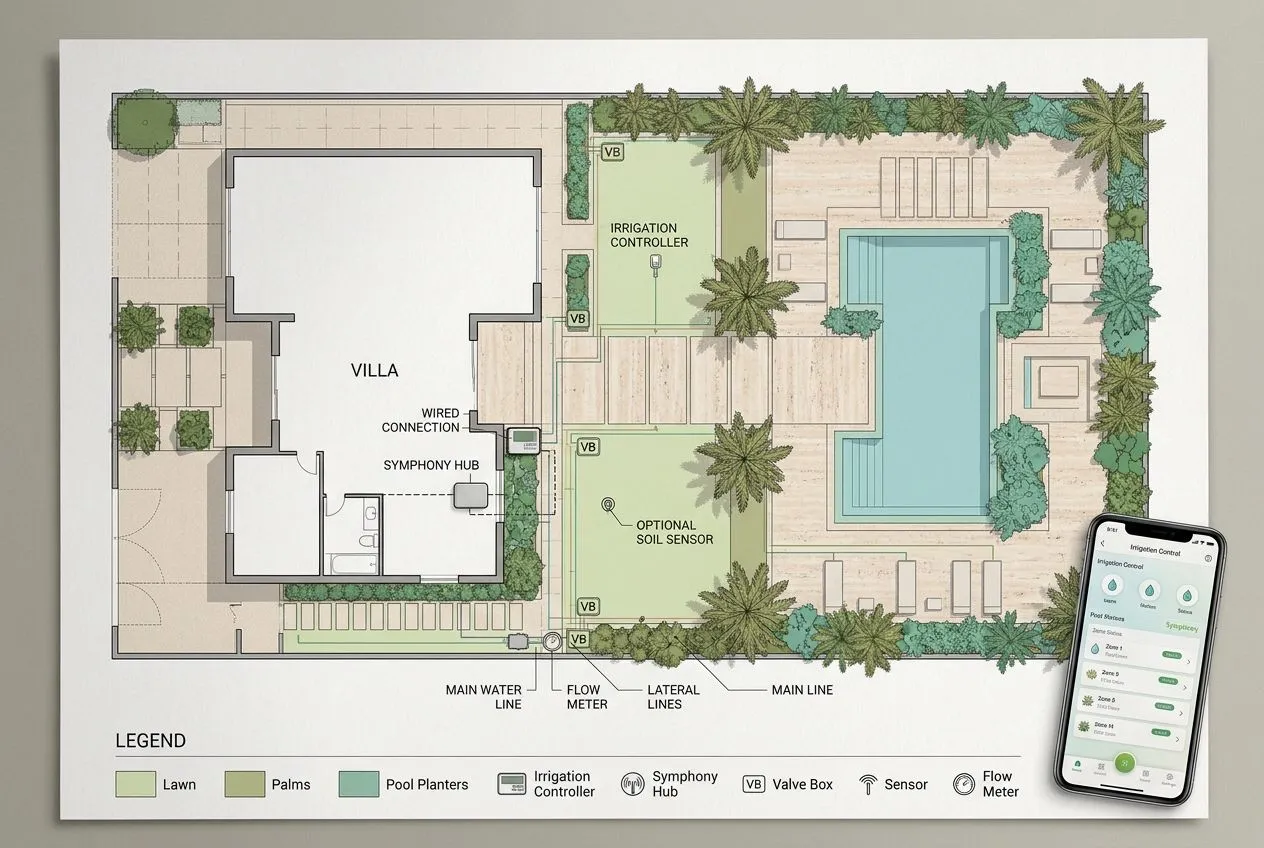
It opens and closes water valves for each part of your garden on a schedule, then waters less or skips a run when the weather or the soil says so. Each area that is watered separately is called a zone. The lawn, a row of palms and the planters by the pool could each be a zone.
These are the main parts. The sensors are optional, and we help you decide which ones are worth having in your garden.
- The controller: the box that holds the schedule and opens each valve in turn.
- Zone valves: electric valves that let water into one zone at a time.
- Soil moisture sensors (optional): probes in the ground that report how wet the soil is, so the controller can skip a run.
- Rain sensor (optional): stops a run after rain.
- Flow meter (optional): measures how much water is moving, so a burst pipe or broken sprinkler shows up as unusual flow.
How do schedules and weather data work together?
The schedule sets the baseline and the controller's own weather service adjusts it. You or our engineer set start times and run times for each zone. The Rain Bird or Hunter controller then changes those run times using the brand's own online weather service. Symphony does not feed it the weather.
Hunter's Hydrawise software looks at local weather data and adjusts watering before it happens. Hunter calls this Predictive Watering. Rain Bird's Automatic Seasonal Adjust works out a daily evapotranspiration rate for your area, which means how much water the soil and plants lose to heat and sun. It then changes run times to match.
DEWA, Dubai's electricity and water authority, advises watering before 8am or after 6pm to cut evaporation. It also advises adjusting sprinkler timers to the season and the weather. A weather-adjusted controller makes that seasonal change for you, so you are not resetting timers by hand every few months.
Rain is rare here. The Dubai Government Media Office puts average rainfall at about 87 mm a year. That is why soil moisture and flow readings usually tell you more than a rain sensor does.
What happens if the internet goes down?
Your watering schedules keep running. Rain Bird and Hunter controllers store their schedules inside the controller, and our hub (the small box in your home that runs your system) works without the internet.
You lose control from outside the home. You also stop getting fresh weather adjustments, because these come from the brand's online service. According to Hunter's manual, a Hydrawise controller that loses its connection keeps running the schedule it last synced.
At home, the Avario app still works over your home Wi-Fi. If the home network itself goes down, your keypads keep working.
How does irrigation link to the rest of the villa?
Once the controller is connected to Symphony, your garden follows the same rules as the rest of your home and its status sits in one app. You stop switching between the irrigation app, the lighting app and the AC app.
These are links we set up regularly. Our engineer can talk them through with you at the home visit:
- Pausing the sprinklers while an outdoor scene is on, so guests on the lawn stay dry.
- Seeing in the app which zones ran, when and for how long.
- An alert in the app when the flow meter sees water running where it should not.
- Tying the garden into your indoor water sensing. This can be a simple alert or go as far as closing a valve automatically.
Garden lights often share the same controls, which our guide to garden and pool lighting control covers. For leaks inside the villa, see water leak detection and automatic shut-off.
Can you make an existing garden smart?
Usually, yes. First our engineer checks what you already have. If your valves, wiring and controller position are in good condition, we reuse as much of them as we can.
Equipment that is worn or doesn't work with a smart controller needs replacing. We tell you which parts fall into each group before you get the quote.
Who does what on site?
We supply the equipment, and our own team handles all the programming and commissioning (setting the system up and testing it). Your irrigation contractor handles the plumbing side. A project usually runs like this:
- Our engineer visits and looks at the garden, the water supply and where the controller and hub will go.
- We plan the zones, sensors and controller with you and your irrigation contractor.
- We supply the irrigation equipment, including any sensors you choose, and your contractor installs the pipework, valves and sprinklers.
- Our team connects the controller to Symphony, sets up the schedules and links, and tests each zone.
- At handover you get the written system records and drawings, and we show your household how to use the system.
The outdoor products we fit are IP rated and tested in Dubai heat. IP rated means they are sealed against dust and water to a stated level.
Do you need the whole system for a small garden?
Not always. For a terrace with a few planters or a small courtyard, a standalone smart controller with its own app is usually enough, and we will tell you so.
Linking irrigation to Symphony is worth it in these cases:
- Your garden has many zones, such as lawn, trees, beds and pool planting.
- You already have a smart home, or you are planning one.
- You travel for long spells, or the villa is a holiday home, and you want to check the garden from abroad.
- You want watering, lighting and leak alerts in one app rather than several.
What affects the cost?
It depends on the size of the garden and how much of it you want linked to the rest of the home. Our engineer bases the quote on what they see at the home visit.
- The number of zones and the size of the garden.
- New build or existing garden, and how much of the existing equipment we can reuse.
- How the controller connects to the hub: by cable on a wired system, or over your network on a wireless one.
- Which controller you choose, and whether you add soil moisture, rain or flow sensors.
- How many links you want to lighting, leak sensing and other systems.
Who looks after it after handover?
We can. We build each maintenance plan around what the customer needs. Your plan can cover the irrigation controller and its sensors, including checks on the flow meter and soil sensors.
If something stops working, you can message us through the support chat in our app, Monday to Saturday, 8am to 7pm. Read more about smart home repair and maintenance.
For garden designers, architects and contractors
Bring us in before the irrigation layout is fixed. The earlier we join, the better. We work from your drawings, so the controller position, the cable route to the hub and the sensor locations are planned with the zones rather than added afterwards.
We supply the equipment, work with the irrigation contractor on site and set up the system so it runs with the rest of the villa. See how we work with contractors, developers, designers and installers.
Questions people ask
Can I control my garden watering from my phone? Yes. Once the controller is linked to Symphony, you can see and change watering in the Avario app, along with your lights and AC.
Does smart irrigation work without the internet? Yes. Rain Bird and Hunter controllers and our hub keep running their schedules. You lose remote access and fresh weather adjustments until the connection comes back.
Which irrigation brands do you work with? We connect Rain Bird and Hunter controllers. Weather-based adjustment comes from each brand's own online service.
Do I need soil moisture sensors? No, they are optional. They help most in large gardens with mixed planting, and our engineer will tell you whether they are worth adding to yours.
Who installs the pipes and sprinklers? Your irrigation contractor does. We supply the equipment, then connect, set up and test the control side.
What is the next step?
Book a home visit so our engineer can look at your garden and your existing controls. Our team gets in touch the next business day to arrange the visit, and you usually get a written quote within 2 days of it.